

Career pathing sounds simple in theory. Show employees where they can go next, help them understand which roles might fit, make development expectations clearer, and give managers better tools for career conversations.
But there’s one part that can quietly stall the whole thing: someone has to build all the content. Role descriptions, career pathways, skills, interests, development ideas. For most organizations, that’s where a promising career pathing initiative slows down.
That's the problem Senda, Happy Path's new AI assistant, was built to solve.
The Hidden Workload Behind Career Pathing
Most organizations already have a lot of useful information: job descriptions, org charts, HRIS data, competency frameworks, existing learning content. The problem is that it's usually scattered, inconsistent, or not structured in a way employees can actually use.
Turning that into a real career experience can mean months of writing role descriptions, mapping career moves, aligning roles to your competency model, and reviewing it all with subject-matter experts, before an employee ever sees the platform.
What Senda Actually Builds
Senda is Happy Path's AI-powered content assistant. Instead of starting from a blank page, your team can use Senda to generate a strong first draft of the content your organization needs:
- Role profiles: clear, employee-friendly descriptions of what each role involves
- Career pathways: suggested moves between roles, departments, or levels
- Competency alignment: with your model, Senda can align competencies to roles.
- Interests and preferences: factors that help employees understand whether a role fits how they like to work
- Activities: the typical tasks and day-to-day work performed in the role
- Work environment: what employees can expect on the job, from office-based work to field-based settings
- Education: typical required and preferred education, including areas of study, specialties, and certifications
- Assessment content: questions and prompts that support self-assessment and development conversations
- Development ideas: practical next steps employees can take to prepare for future roles
Senda also links role requirements to the learning resources you already have, so development ideas connect to something employees can actually act on.
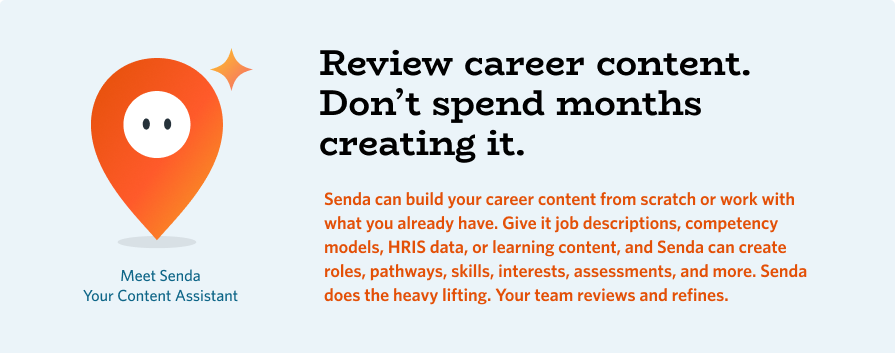
Senda Creates the Draft. Your Team Keeps the Judgment.
This distinction matters. Senda isn't designed to make talent decisions. It's designed to give your team a much better starting point.
Without Senda: Blank page → meetings → drafting → more meetings → revisions → configuration → months, months, and months before publishing.
With Senda: Existing content → Senda draft → expert review → publish in days or weeks.
Your people still decide what's accurate, what's missing, and what needs to change. They just spend a lot less time on the mechanical work of getting there.
Why this Matters Most at Launch
The biggest content burden usually comes at the very beginning, when an organization needs to define departments, job families, role profiles, and career moves for dozens or hundreds of roles before anyone can log in.
That's where Senda has its biggest impact, and where it can change the conversation entirely. Instead of "we love the idea, but we don't have the bandwidth to build it," the question becomes "what information do you need from us to get started?"
Senda is Entirely Optional
Worth saying plainly: you don't need Senda to use Happy Path. The platform works fully on its own. If your team has the time and expertise to build and maintain career content in-house, that path works just as well.
Senda exists for organizations that don't have that bandwidth, or that would rather spend their time on the conversations and decisions that actually need a person, not on writing the first draft of a hundred role profiles. Some teams use Senda to build everything. Others use it to fill in a handful of gaps. Either way works.
Organizations don't stand still. New roles get created, responsibilities shift, departments reorganize. Without upkeep, even a well-built career pathing platform can start to feel out of date within a year.
Senda can help with that too, adding a new role, updating an existing one, refreshing an interest list, so career architecture becomes something you maintain gradually instead of a project you have to redo.
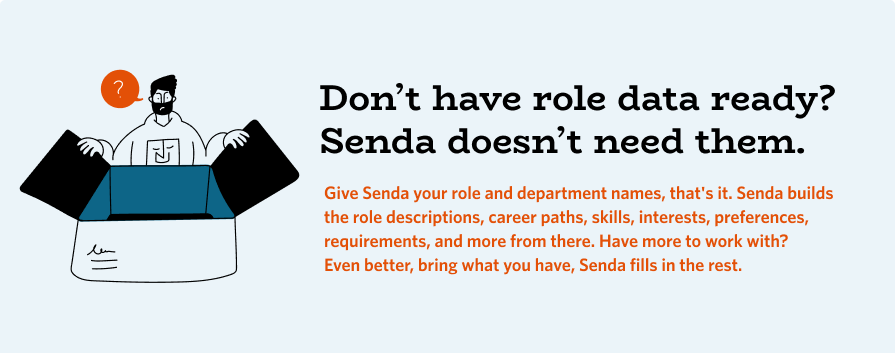
What You can Give Senda
You probably already have more than you think, job descriptions, an org chart, existing competency models, an HRIS export. Senda uses what you already have as a foundation and helps turn it into something employees can actually explore.
Don’t have any of that ready? That’s fine too. Senda can start with nothing more than your role and department names and draft the rest from there, including career pathways, skills, interests, and work activities. If you have a competency model, Senda can align your roles to it.
Bring what you have, or tell Senda who does what. Either way, Senda builds what's missing.
Career Pathing, Without the Content Bottleneck
Career pathing sounds simple in theory. Show employees where they can go next, help them understand which roles might fit, make development expectations clearer, give managers better tools for career conversations.
But there’s one part that can quietly stall the whole thing: someone has to build all the content. Roles, career paths, skills, interests, development ideas. For most organizations, that’s where a promising career pathing initiative slows down.
That's the problem Senda, Happy Path's new AI assistant, was built to solve.
Learn More:
Career Pathing 101 for Real-World Teams: Start Simple, Grow Fast