

If you’ve been around HR long enough, you’ve seen this movie.
A People team rolls out a “skills matrix” or self-assessment with good intentions… and the employee reaction is immediate:
- “Are we being ranked?”
- “Is this for layoffs?”
- “Is this a secret performance list?”
- “Should I downplay weaknesses?”
And just like that, the matrix stops being a development tool. It becomes a trust problem.
Here’s the truth: skills assessments can be incredibly helpful—especially for small and mid-sized teams—if you design them for the real world:
- limited bandwidth
- limited data maturity
- managers with uneven coaching skills
- employees who are understandably cautious
This guide shows you how to build a skills matrix that feels safe, useful, and actually leads to growth—without turning into corporate surveillance.
Why skills assessments trigger anxiety
Employees don’t panic because they hate development. They panic because they’ve seen assessments misused.
A skills matrix goes sideways when it’s unclear:
- why it exists
- how the results will be used
- who will see it
whether it impacts pay, promotion, or job security
If you don’t answer those questions upfront, others will. Usually, with the worst-case assumption.
The result is predictable:
- people self-rank defensively
- managers avoid honest conversations
- the data becomes unreliable
- the tool loses credibility fast
So the first design principle is simple:
Trust comes before data.
The "good" version of a skills matrix (what it is and what it isn't)
Let’s strip out the jargon.
A good skills matrix is:
- a shared language for “what good looks like”
- a development flashlight, not a test
- a way to identify 2–4 meaningful gaps
- a bridge from “I want to grow” → here’s the plan
A good skills matrix is not:
- a layoff tool
- a ranking system
- a pass/fail exam
- a substitute for performance management
- an attempt to build a global skills ontology
For SMBs, the best matrices are small, role-based, and action-oriented.
Step 1: Start with one role family (pilot, don't broadcast)
If you try to roll this out org-wide, it will feel like “a new regime.”
Instead, pilot with one area where the value is obvious:
- a growing team
- a high-turnover group
- a role with clear levels (Sales, CS, Engineering, Finance)
Pilot scope: 1 job family, 5–10 roles max.
Why pilot matters:
- you build credibility with a small group
- you catch language problems early
- you learn what employees interpret as “threatening”
- you create examples and success stories for the rest of the org
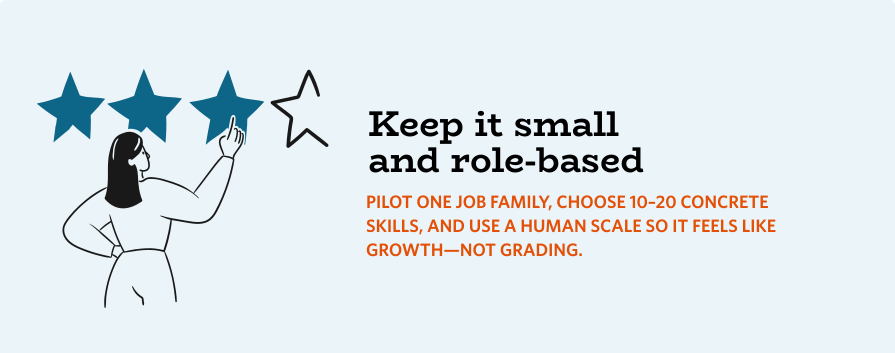
Step 2: Define 10-20 skills that actually matter (not a taxonomy)
Most skills matrices fail because they try to be comprehensive.
You don’t need 120 skills. You need the ones that predict success in a role.
For each role, pick:
- 5–8 core skills/behaviors
- optionally 3–5 role-specific skills
- optionally 2–3 “operating skills” (communication, prioritization, stakeholder management)
Keep skills concrete and observable. Examples:
- “Clarifies requirements with stakeholders”
- “Writes clear, decision-ready documentation”
- “Diagnoses root cause vs symptom”
- “Manages priorities without dropping commitments”
Avoid vague skills like “leadership” unless you define what that means at your company.
Step 3: Use a rating system that feels safe and human
Don’t use “1–5 proficiency” if it reads like a performance score.
Try a development-friendly scale:
- Exploring — Just getting started (no worries—learning mode!).
- Informed — I’m familiar with it and can do some basics with a little help or reference.
- Capable — I can do this on my own for most day-to-day needs.
- Advanced — I’m very comfortable and can support others or take on tougher situations.
- Expert — Go-to person who can guide others and help shape how we do it.
Then add one critical layer that changes everything:
Add time horizon: "today" and "next"
Ask two ratings:
- Where am I today?
- What level do I want in 6 months?
This frames the conversation as growth, not judgment.
Step 4: Make the self-assessment psychologically safe
If you want honest self-assessments, you must remove the threat.
Here’s a simple “trust contract” you can literally paste into your rollout:
This self-assessment is for development.
- It is not used for layoffs, compensation decisions, or performance ratings.
- Your results are used to build learning plans and coaching conversations.
- You control what you share beyond your manager / HR pilot lead (depending on your model).
Then reinforce safety in practice:
- don’t compare employees publicly
- don’t publish rankings
- don’t use it as “proof” in performance conversations
- don’t tie it to layoffs, reorgs, or headcount reduction work
If you break trust once, you won’t get it back.
Step 5: Pair self-assessment with manager alignment (without making it scary)
Self-assessment alone can be inaccurate—either overly harsh or overly optimistic.
A simple, healthy approach:
- employee completes self-assessment first
- manager completes a “manager view” version
- they review together and agree on 2 priorities, not 20
Important: the goal is not “who’s right.”
The goal is:
- shared understanding
- concrete next steps
- less “vibes-based” feedback
If you want to reduce tension, use a neutral prompt:
“Where do we see it differently, and what evidence would help?”
Step 7: Measure adoption with signals, not perfection
You don’t need perfect data. You need useful behavior change.
Track simple pilot signals:
- % of employees who completed self-assessment
- of 1:1s where career goals were discussed
- of learning plans created
- changes in “I can see a future here” pulse responses
- internal mobility moves (even lateral)
- retention in the pilot group
The point is to prove the matrix is helping people move forward—not to create a perfect dataset.
Where software helps (and where it shouldn't)
Software helps if it:
- keeps expectations consistent across managers
- makes assessments quick and approachable
- turns gaps into action plans
- links actions to learning/resources
- makes it easy to update over time
Software hurts if it:
- forces a complex taxonomy
- takes months to implement
- requires heavy governance
- creates admin burden that small teams can’t sustain
For SMBs, the best tool is the one employees actually use—and the one managers can sustain.
How Happy Path fits (trust-firts, right-sized)
Happy Path is built to make career pathing and skills assessment practical for small and mid-sized teams—without enterprise bloat.
It helps you:
- map roles and pathways in a way employees can browse
- run lightweight self-assessments tied to role expectations
- show strengths and meaningful gaps (not overwhelming dashboards)
- connect gaps to learning and development actions
- create simple plans employees and managers can revisit
Most importantly, it’s designed for clarity and development, not surveillance.
Bottom Line
A skills matrix can either:
- unlock better coaching, clearer growth paths, and higher retention
or - destroy trust and become a corporate rumor generator
The difference is simple:
Make it role-based. Make it small. Make it safe. And make it actionable.
Learn More:
Career Pathing 101 for Real-World Teams: Start Simple, Grow Fast
How Happy Path Serves SMBs, Associations, and Public Utilities